
How to Have Fun
as an adult in a burning world

I began working on this letter — an essay about FUN — over two months ago. The first draft came together quickly, written in a single gasp following a stretch of reading and real-world research. Then it sat. I held off on releasing it because, ironically, it wasn’t very fun.
Or perhaps because I wasn’t.
On a micro, personal scale, I’ve been consumed by struggles and questions that I’m not (yet) inclined to divulge to the internet. But may it suffice to say that writing about joy and lightness felt disingenuous when my everyday experience said otherwise.
On a macro, global scale, there is something fundamentally off about espousing the benefits of play amid a chaotic and troubling time. Whenever I sat down to work on it, I was haunted by an image of an adult (a central casting adult, with a humorless face and a three-piece suit) playing in a sandbox amidst a burning world. What exactly was I trying to promote?
Yet I kept returning to it, as the data suggested otherwise. Fun is soothing, enlivening, even medicinal. It lowers cortisol levels, provides a mental reset, promotes neuroplasticity, and fosters creativity and innovation. Far from a silly distraction, fun is a powerful ingredient in our well-being. And it is needed now more than ever.
*
Because I’m a researcher by nature, I decided to read everything I could find on the subject, from Freud and Jung to the questionable treatises of self-help influencers. What constitutes fun and why is it necessary? Is it as beneficial for adults as it is for children? (Yes.) How do we fit it into our busy modern lives?
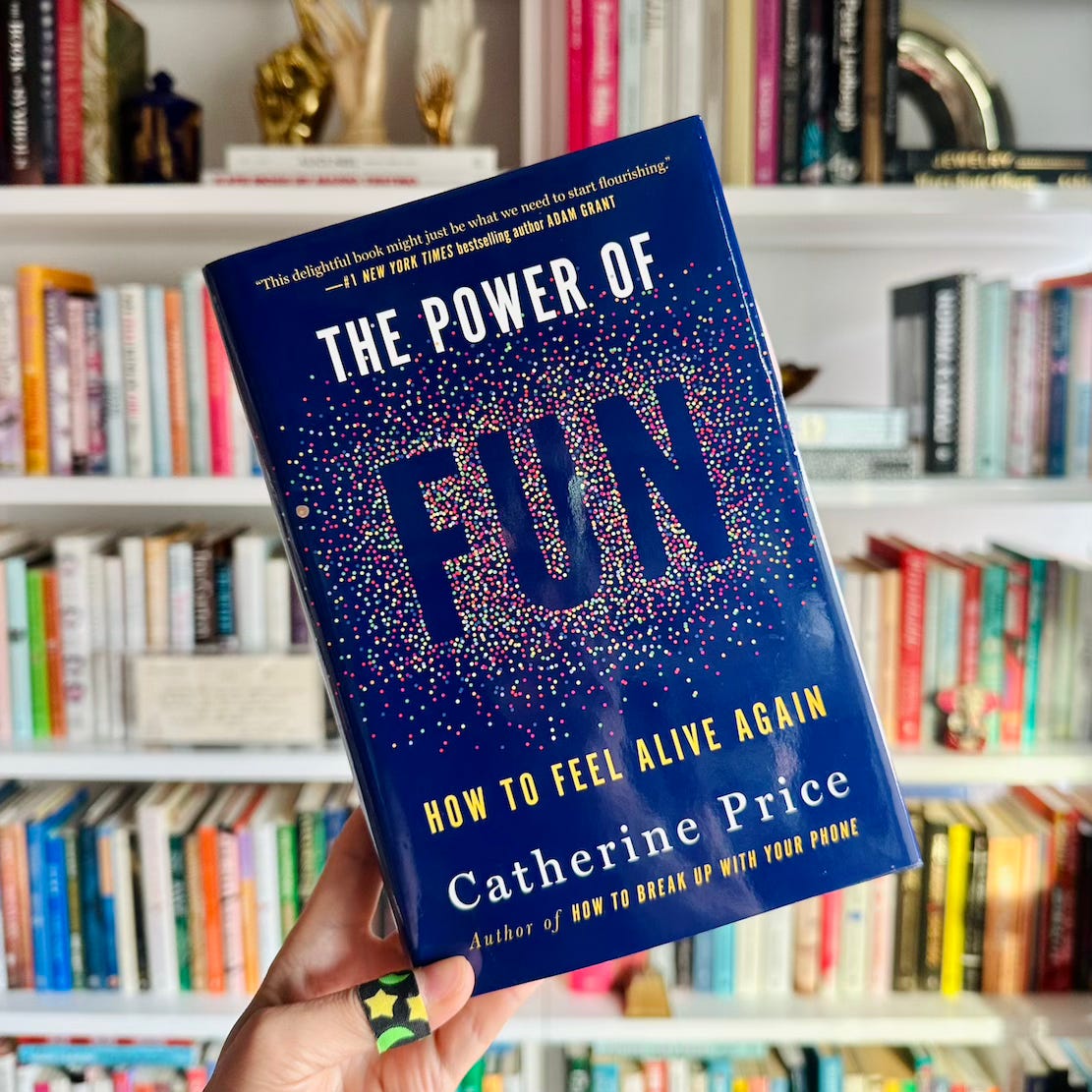
In The Power of Fun, which boasts 290 pages devoted to the topic, author Catherine Price divides fun into two buckets — “true fun” and “false fun.”
False fun, as its name suggests, merely masquerades as such. And it is everywhere. Consider the human tendency to say we’re doing something “for fun” when pursuing anything that isn’t related to work or obligation. Just because something is voluntary doesn’t mean it meets our definition of fun. “Do an internet search for ‘how to have fun’ and you’ll quickly encounter evidence of how broadly and sloppily we use the word,” Price writes.
“‘Roast a turkey,’ suggests a list of ideas from CNN, which also includes encouragements to get more sleep, to ‘put together an altar to honor loved ones who have passed,’ and to watch a documentary about climate change. A similar list from Real Simple magazine proposes that if you want to have more fun, you should make snickerdoodles, ‘get everyone some fun back-to-school supplies,’ and — I swear I am not making this up — ‘adorn your table with gourds.’”
I love a good gourd as much as the next person, but unless we’re talking about my household’s annual read-aloud of the viral McSweeney’s essay, which does tend to result in an eruption of laughter, gourds have rarely resulted in fun.

True fun, Price contends, doesn’t rely on the doing of any activity. It needn’t involve LEGO, a sandbox, a pickleball court, a game of charades, or a round of bar trivia. (Though it could!) It can happen alone, with friends or family, or with strangers; in nature, while moving, at home, or in stillness. What differentiates it is its energy. Fun is lighthearted, joyful, exuberant, buoyant, electric, liberating.
True fun results from “the confluence of playfulness, connection, and flow.” Two out of three of these will still create an enjoyable, worthy experience. But for something to qualify as capital F Fun, it must flirt with all three.
One important thing to note is that fun does not equal numbness.
In other words, scrolling is not fun.
To that end, a significant portion of the book is dedicated to the tyranny of phones (my language, not hers) and their ability to sap our lives of fun and enjoyment. Where we direct our time and attention affects our moods and emotions. Surely not everything — or even most things — we encounter over the course of our day will be fun. But when we can choose where to put our attention in a given moment, we are making a move against every other option. When we make the choice to numb or scroll, we are actively disconnecting from all other possibilities. We lose touch with what’s happening in the moment. We lose touch with our intuition. We lose track of time. We are forfeiting an opportunity to find playfulness, connection or flow.
In other words, when we choose numbness, we are opting against fun.
*
I hear it often — from friends, clients, my inner critic. Life is busy and laden with responsibilities. There isn’t room for play.
Society has led me to believe that prioritizing fun is frivolous, silly, and wasteful; any adult worth their salt has more important things vying for their time and energy. “Play” gets lumped into the same treacly bucket as “inner child” — undeniably valid and worth exploring yet eliciting a small internal shudder.
Yet Einstein said, “Play is the highest form of research.” And who am I to argue?
The reasons against prioritizing fun — too busy; not enough time; an abundance of serious and important life stuff vying for our attention — turn out to be the best reasons for pursuing it. Our attention is valuable and finite. Yet so much of it can be diverted and consumed by headlines, drama, advertisements, and distractions. To show up for life’s demands as whole and refreshed as possible, our minds and bodies need a well-deserved recess. While society may tell us otherwise, play is as fundamental as sleep or food or water. And it remains so no matter the shape or season of your life.
Perhaps the best argument working in its favor is that fun and play are medicinal. The endorphins that are released by joy and laughter help buffer against the physical and psychological effects of stress. Play isn’t just enjoyable, it’s nutritive. Having fun gives us more resilience in the inevitable moments when life is anything but.
*
So, let’s say we’re in agreement that fun is beautiful and important and maybe even biologically necessary. That still doesn’t make it accessible. In a world that is often very un-fun, how do we go about finding it?
According to Price, fun is something we must almost trick into existence. “True Fun is like romance: we can set the mood for it, but if we try too hard, our attempts will likely backfire.” What helps it along? Space. Excitement. A sense of novelty.

I’ve found joy in stand-up comedy, in pets, in all-time-favorite viral videos. I’ve encountered it in quirky dance classes and walks in nature and exploring new-to-me places. It has revealed itself in baking and holiday decorating and gatherings and games.
There are friends with whom I have a better chance of encountering fun, or perhaps more accurately, where it has a better chance of finding me. Sometimes life allows me to forget it, but making time for a walk or a meal or a catch-up call — whatever schedules and geography allow — does wonders for the soul.
If it’s been a minute since you’ve courted fun, or you’ve lost touch with what it means for you, a good place to start is (you guessed it) putting down the phone. Go out into the wide world — connect with nature, culture, like-minded people. Notice the kind of interests and experiences you naturally gravitate toward in any moments of down time. Do you crave movement? Stillness? Consider activities you enjoyed at other times of your life, including childhood. Did you enjoy drawing, sports, singing, crafts…and how might that translate into your life today? Are there any hobbies or curiosities you’ve wanted to explore?
As I contemplated where and how to foster play, I thought of these words from the late doctor, runner, and writer George Sheehan:
“Joy comes at the peak of an experience and then always as a surprise. I cannot have joy on demand. At best, I go where I have felt it before…And then I have that fusion where it all is play and I am capable of anything. I become a child.”
It sometimes seems like the true work of our lives is returning to who we are at our core, before the world got in the way. The central question of who we are, and what are we capable of, dwells somewhere beyond our rational mind, beyond social conditioning, indoctrination, and invalidation. How can we connect to our inner wisdom and passion? How can we return to our essence, our natural state of being? The answer may very well be play.
*
I ended the previous post with a George Bernard Shaw quote, and it seems oddly fitting to do it again:
“We don’t stop playing because we grow old, we grow old because we stop playing.”
In recent days, several wise people have told me that age is a mindset, a feeling, a matter of perspective. I hope mine is imbued with a spirit of play. I wish the same for you.
As always, thank you for reading. x
I think I got into tarot because it was fun! And that brought me back to you, who I had been a huge fan of back in the Cup of Jo days. And now your newsletter is fun. Reading it while listening to the rain instead of cleaning the kitchen or unpacking from vacation. Shopping local is fun. Becoming a regular in the bookstores and coffee shops and refillable stores in my town. Lifting heavy is fun. Puppy play dates. I’d love to hear what others find fun too. What a great topic.
Ages ago, I went to the Monterey Bay Aquarium and was told that otters don't do anything that isn't fun. From that moment forward, I decided to otter-fy my life. Sure, we all have to do things that aren't fun, categorically. But we can have fun before and after. I'll still try to force some in during. A dark, dry sense of humor comes in handy in that regard. So does swearing. Stringing together a lyrical line of swear words is never not fun. I sometimes even surprise myself. xo